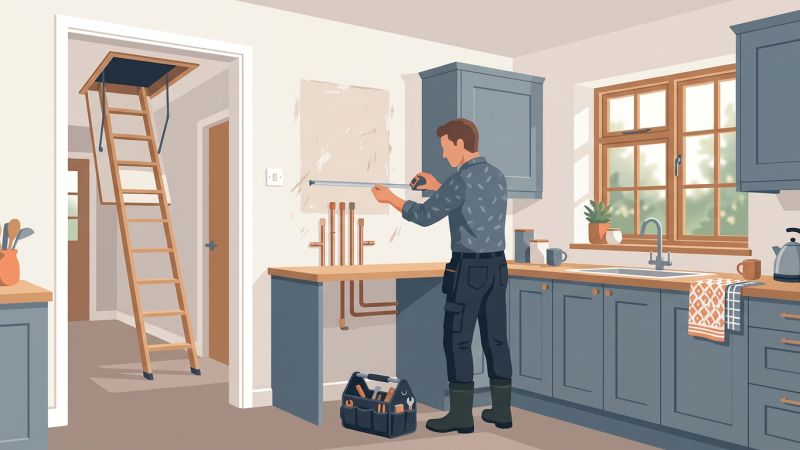
How much to move a boiler: prices by distance and location
Moving a boiler adds £150 to £1,500 to the price of a boiler swap, depending on how far it goes and what stands in the way; a move to another room on the same floor is usually £300 to £1,000 extra. Installers price it as an extra because a relocation is two jobs in one: the swap itself, and the new pipework, flue and making good the new position demands, so that is how the table below presents it. The fitted totals assume a mid-range combi at the £1,800 to £3,500 baseline used across our new boiler cost guide.
| Where the boiler is going | Relocation extra (on top of a swap) | Typical fitted total with a new combi | What drives the figure |
|---|---|---|---|
| 1-2 metres along the same wall | £150-£400 | £2,000-£3,500 | Short pipe extensions, new flue hole, making good the old one |
| Different wall in the same room | £300-£600 | £2,200-£3,800 | Pipes rerouted under units or in the ceiling void, new flue route |
| Next-door room on the same floor (utility, hallway, garage) | £400-£900 | £2,400-£4,200 | Longer gas and water runs, new condensate drain, electrics |
| Different floor (kitchen to a bedroom cupboard, airing cupboard) | £500-£1,000 | £2,500-£4,500 | Pipes through floors, often a new flue through a different wall |
| Loft | £700-£1,500 | £3,000-£4,800 | Vertical flue through the roof, condensate pump, boarding, ladder and light |
| Garage or outbuilding | £500-£1,200 | £2,500-£4,500 | Long pipe runs, frost protection, sometimes a 28mm gas pipe |
Two patterns are worth noticing. The cost of moving a boiler rises faster with the number of obstacles than with the distance: four metres through an open ceiling void is cheaper than one metre through a tiled wall. And the flue decides more than anything else. Any position that forces a vertical flue through the roof, or a long horizontal run with bends, pushes you to the top of the range.
These are national ranges; London and the South East are often £200 to £500 higher for the same job.
What actually happens when you move a boiler?
The engineer runs new gas, water and electrical supplies to the new position, fits a new flue and condensate drain, and makes good where the old boiler was; it usually takes one and a half to two days. On a like-for-like swap the new boiler hangs where the old one did and reuses the existing gas, water and electrical positions. A relocation adds every one of these steps:
- New gas supply run. Modern combis usually need 22mm pipe from the meter, and a long run may need 28mm for part of it.
- Flow and return pipework. The heating circuit has to be extended to the new position and the old tails capped or removed.
- Cold main and hot water pipework. For a combi, the cold feed moves with the boiler and new hot water pipe runs back to the taps.
- New flue. A horizontal kit for an outside wall, or a vertical kit with a roof flashing or lead slate.
- Condensate drain. Condensing boilers produce a few litres of acidic water a day that must reach a drain. If there is no gravity route, a condensate pump is fitted.
- Electrics. A fused spur or socket at the new position, and the controls wiring moved or replaced with a wireless thermostat.
- Making good. The old flue hole is bricked and plastered, pipe holes filled, tiles or units reinstated.
Our timing guide on how long it takes to fit a boiler sets this out hour by hour.
Can you move a boiler yourself, or keep the old boiler and just move it?
Can you move a boiler without an engineer? No. Disconnecting, moving and reconnecting a gas appliance is gas work, and in the UK it must be carried out by a Gas Safe registered engineer. The same goes for the flue, which is part of the appliance for regulatory purposes. A DIY move is illegal, voids the guarantee and leaves you unable to prove the installation is safe when you sell. Boxing in the pipework and decorating afterwards are the only parts you should do yourself.
Moving an existing boiler rather than fitting a new one is legal but rarely sensible. The flue has to be new anyway, the old seals and valves are disturbed, and the engineer still has to drain, refit, refill and recommission everything: expect £500 to £1,500 for a boiler that may be halfway through its life. Many installers decline the job outright. If your boiler is under about five years old and still under guarantee, ask the manufacturer whether the guarantee survives a move; if it is older, our guide to how long a boiler lasts will help you judge whether it is worth keeping at all.
What affects the boiler relocation cost most?
The flue route, the gas pipe run, the condensate drain, the making good and the destination's own requirements. These five factors explain most of the gap between a £300 move and a £1,500 one.
- Flue route. A horizontal flue through an outside wall costs £80 to £150 in parts. A vertical flue through a pitched roof is £200 to £500 fitted, needs a flashing or lead slate, and may need scaffolding or a roof ladder. The clearance rules that decide where a terminal can go are explained in boiler flue regulations, and they often rule out the cheapest-looking position.
- Gas pipe length and size. Each extra metre of 22mm copper is a small cost in itself, but routing it neatly through floors and voids is slow work. Very long runs sometimes need 28mm for the first section to keep the gas pressure at the boiler within limits.
- Condensate drain. A boiler next to a kitchen sink waste drains by gravity for the cost of a metre of plastic pipe. A loft or bedroom position often needs a condensate pump (£100 to £300) or a long insulated external run.
- Access and making good. Lifting floorboards, chasing walls, retiling behind a kitchen run and plastering old holes can add £150 to £600 on their own. A move during a kitchen refit, when the walls are already open, is much cheaper than a move into a finished kitchen.
- The new location's requirements. Manufacturers' installation instructions typically require a loft to have a boarded floor, a fixed ladder, a guard rail around the hatch and a light before the boiler can be installed there. Garages need frost protection on every pipe. Bedrooms and bathrooms restrict which boilers can be fitted at all.
Which hidden extras appear on a relocation invoice?
The items most often missing from a quick quote are the vertical flue, plume kit, condensate pump, gas pipe upgrade, scaffolding and loft access works. Relocation quotes vary more than swap quotes because installers make different assumptions about what is included. Ask for each of these to be listed as included, excluded or not needed.
| Extra | Typical cost | When it applies |
|---|---|---|
| Vertical flue kit and roof flashing | £200-£500 | Loft moves and boilers on internal walls |
| Plume management kit | £80-£200 | Terminal would discharge towards a path, window or neighbour |
| Condensate pump | £100-£300 | No gravity fall to a drain from the new position |
| Gas pipe upgrade or long run | £150-£400 (more for 28mm or very long runs) | Almost every relocation beyond the same wall |
| Scaffolding or roof access | £200-£600 | Vertical flues on taller houses, terminals above head height |
| Loft boarding, fixed ladder, light | £200-£600 | Required by manufacturers for loft installations |
| Electrical spur and controls wiring | £80-£250 | New position has no suitable supply |
| Making good: plaster, tiles, units | £150-£600 | Old boiler position and new pipe routes |
| New cupboard or boxing-in | £150-£600 | Boiler is now in a living space and needs hiding |
| Powerflush or chemical clean | £300-£800 | Older system being disturbed and refilled |
| Magnetic filter | £100-£200 | Recommended with any new boiler, often a guarantee condition |
| Removing old pipework and capping | £50-£200 | Dead legs left in the old position |
Most of these also appear on ordinary installation quotes, and our breakdown of labour, parts and extras explains what each one should cost in detail. On a relocation, the first six are the ones most likely to be missed from a quick quote and added on the day.
Worked examples: what does moving a boiler cost in three real situations?
The figures below use the ranges above with a mid-range combi from a major brand. If your quotes sit far outside them, ask the installer to walk you through the difference.
Example 1: three-bedroom semi, boiler moved 2 metres along the kitchen wall during a swap
The old boiler sits above the worktop; the owners want it in the corner so a new run of wall units can go in.
| Item | Typical cost |
|---|---|
| 28-30kW mid-range combi, standard swap elements | £2,000-£3,000 |
| Pipe extensions, new flue position, cap old flue hole | £150-£300 |
| Plastering and retiling the old position | £100-£250 |
| Total fitted | £2,250-£3,550 |
This is the move most people can justify. The boiler is still on an outside wall with a short horizontal flue, the condensate still runs to the sink waste, and the whole job fits in one long day.
Example 2: terraced house, boiler moved from the kitchen into the hallway cupboard under the stairs
Here the attraction is a clear kitchen wall. The cupboard is on an internal wall, so the flue cannot simply go straight out.
| Item | Typical cost |
|---|---|
| 30kW mid-range combi, standard swap elements | £2,000-£3,000 |
| Gas, flow, return and water pipework rerouted (4-6 metres) | £250-£500 |
| Horizontal flue run with bends to the nearest outside wall, or vertical flue | £150-£500 |
| Condensate pump | £100-£300 |
| Electrical spur, making good in the kitchen | £150-£400 |
| Total fitted | £2,650-£4,700 |
The flue is the swing factor. If the cupboard backs onto an outside wall and the terminal clears the front door by the required distance, the job stays near the bottom of the range. If not, a vertical flue up through the landing and roof pushes it towards the top.
Example 3: four-bedroom detached, boiler moved from an upstairs bedroom to the loft
A common request when a bedroom is being reclaimed. The homeowners are moving the boiler to the loft so the airing cupboard can be removed entirely.
| Item | Typical cost |
|---|---|
| 30-35kW mid-range combi, standard swap elements | £2,100-£3,200 |
| Vertical flue through the roof with flashing | £250-£500 |
| Extended gas supply, flow and return, cold and hot pipework | £300-£600 |
| Condensate pump or insulated drain route | £100-£300 |
| Loft boarding, fixed ladder, guard rail, light | £200-£600 |
| Pipe insulation and frost protection | £50-£150 |
| Making good the bedroom wall and ceiling | £100-£300 |
| Total fitted | £3,100-£5,650 |
Moving a boiler to the loft is the most expensive common relocation, and the one with the most long-term trade-offs, which the next section covers. Before committing, check the boiler is correctly sized for the new, longer pipe runs using our guide to what size of boiler you need.
Is moving a boiler to the loft a good idea?
It is a good idea when you want the space back and accept ladder access for pressure top-ups and a stricter installation; it is a poor idea purely to hide the boiler. The loft is popular because it frees a kitchen wall or a whole cupboard, but go in with eyes open.
What you gain: a quieter house, a kitchen or bedroom wall back, and a short vertical flue with few clearance problems.
What you give up or must pay for:
- Access for you. Combis occasionally need topping up via the filling loop; if the loop and gauge are in the loft, every top-up means a ladder. Some installers can bring the filling loop down to an accessible point; ask.
- Access for the engineer. Manufacturers require a fixed ladder or stairs, a boarded floor to and around the boiler, a guard rail at the hatch and lighting. Without them, the installation may not be commissioned and the guarantee may be refused.
- Frost. The boiler has frost protection built in (as long as it stays powered), but the pipes do not. Insulation on every run and a carefully routed condensate pipe are essential; a frozen condensate pipe is the most common winter call-out for loft boilers.
- Hot water delay. Water has further to travel to the kitchen tap, so you wait longer.
If the only aim is to hide the boiler, a well-designed cupboard in its current position is usually a fraction of the price. Our guide to boiler cupboards, sizes and clearances shows what manufacturers allow.
When is it not worth moving a boiler at all?
It is not worth it when the only gain is cosmetic and the move forces a vertical flue or a condensate pump. A relocation makes sense when it unlocks something you really want: a kitchen layout, a reclaimed room, or a quieter bedroom; rarely when a boiler simply "looks wrong" where it is.
Think twice if:
- the current position already works well, with a short flue, a gravity condensate drain and good access;
- the move would force a vertical flue and a condensate pump that would otherwise not be needed;
- your boiler is relatively new and you were not planning to replace it;
- the destination is a bedroom or bathroom, where only room-sealed boilers outside the wet zones are permitted and the noise may annoy you.
There is one situation where relocation is almost unavoidable: replacing an old back boiler behind a fireplace, where the new combi cannot go in the same spot. That job is a relocation by definition and is covered separately in our guide to back boiler replacement.
How can you keep the cost of moving a boiler down?
Combine the move with a boiler swap, stay on an outside wall near a drain, and time it with other building work.
Whatever you decide, insist on a Gas Safe registered engineer, ask for the Building Regulations compliance certificate afterwards and keep the itemised invoice.
Frequently asked questions
How much does it cost to move a boiler to the loft?
Moving a boiler into the loft typically adds £700 to £1,500 to the price of a new boiler, so a complete job usually lands between £3,000 and £4,800. The extra pays for a vertical flue through the roof, longer gas and water pipework, a condensate route or pump, and the boarded floor, fixed ladder and lighting that manufacturers' installation instructions require for a loft installation.
Can you move a boiler without replacing it?
Technically yes, but most installers advise against it and some refuse. The flue almost always has to be new, the seals and fittings on an old boiler are disturbed, and labour for disconnecting, refitting and recommissioning runs to £500 to £1,500 before any pipework. If the boiler is more than eight to ten years old, putting that money towards a new one in the new position is nearly always better value.
How easy is it to move a boiler a short distance along the same wall?
This is the simplest relocation there is. The engineer extends the gas, flow, return, cold and hot pipes by a metre or two, drills a new flue hole and makes good the old one. Done at the same time as a boiler swap, it adds roughly £150 to £400 and an hour or two to the day. The main cost is often cosmetic: tiles, plaster or a kitchen unit that has to be altered.
Do I need planning permission or Building Regulations approval to relocate a boiler?
Planning permission is not normally needed for a flue on a house, although flats, listed buildings and conservation areas can have restrictions, so check with your council if in doubt. Building Regulations do apply, but a Gas Safe registered engineer self-certifies the work and notifies your local authority for you. You should receive a compliance certificate in the post within a few weeks.
Will a boiler in the loft or garage freeze in winter?
The boiler itself is protected by its built-in frost thermostat, which fires it briefly when the water inside gets cold. The weak points are the pipes and especially the condensate pipe. A good installer insulates every exposed run, keeps the condensate pipe internal or oversizes and lags any external section, and may fit trace heating. Ask for these to be listed on the quote.
Why do online fixed-price installers often refuse relocations?
Their pricing model relies on a standard like-for-like swap that can be surveyed from photos and completed in a day. A relocation needs someone to walk the pipe route, check the flue position against clearance rules and plan a condensate drain, which is hard to do remotely. Some will quote a move within the same room; most send anything bigger to a local installer visit.
Sources and further reading
- Gas Safe Register - Find a registered engineer
- GOV.UK - Approved Document J: Combustion appliances and fuel storage systems
- GOV.UK - Approved Document L: Conservation of fuel and power
- HSE - Domestic gas health and safety
- Worcester Bosch - Installation and siting guidance
- Vaillant UK - Boiler installation instructions
- Energy Saving Trust - Boilers
Prices and scheme details were checked on 22 October 2026 and are shown as typical ranges. Always get written quotes from Gas Safe registered installers.