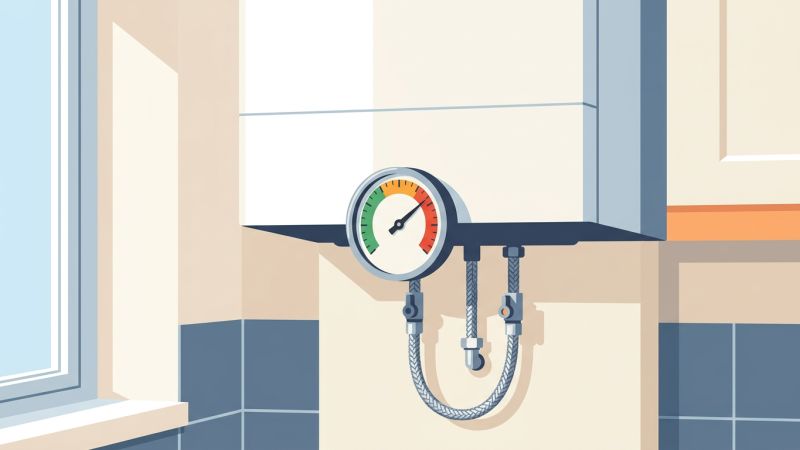
What counts as too high?
Anything above 2 bar on a cold system is higher than it should be, and 2.5 bar or more means you should act before the heating next runs. Our pillar on what boiler pressure should be explains the normal band in detail; the short version is 1 to 1.5 bar cold and up to about 2 bar hot.
| Cold reading | What it tells you | Action |
|---|---|---|
| 1 to 1.5 bar | Normal | None |
| 1.5 to 2 bar | A little high, often from an enthusiastic top-up | Watch it when the heating runs |
| 2 to 2.5 bar | High; little room for expansion | Release a little water once cold |
| 2.5 to 3 bar | Too high; relief valve about to open | Do not run the heating until lowered |
| Above 3 bar | Relief valve discharging outside | Lower it; call an engineer if it will not stay down |
The hot reading matters too. Pressure rising by about half a bar as the radiators warm is normal physics - water expands as it heats. Pressure rising to 3 bar every time the heating is on is a fault, even if the cold reading looks fine.
Why does boiler pressure keep rising?
There are only two ways pressure can rise: more water is getting into the sealed circuit, or the expansion vessel can no longer absorb the expansion of the water already there. The table sorts the common causes by that logic.
| Cause | How it behaves | Who fixes it |
|---|---|---|
| Filling loop left open or not fully closed | Pressure creeps up with the heating off, over hours or days, after a recent top-up | You: close both valves fully |
| Overfilled during a top-up | Cold reading too high from the start; stable afterwards | You: release a little water |
| Filling loop valve or filling link passing | Pressure keeps rising even with the valves apparently closed | Engineer or plumber: replace the valve |
| Expansion vessel lost its charge | Normal cold, climbs towards 3 bar when hot, relief valve may drip, then low once cool | Engineer: recharge or replace |
| Pressure relief valve weeping after lifting | Gauge swings high then low; copper pipe outside drips | Engineer: replace the valve |
| Mains water entering through a combi's plate heat exchanger or filling device | Pressure rises continuously, sometimes to 3 bar overnight | Engineer |
The expansion vessel is a small steel tank inside the boiler with a rubber diaphragm and a cushion of air; when the air escapes, every heating cycle pushes the gauge up instead. Our parts guide explains what the expansion vessel and other boiler parts do if you want the detail.
How do you lower boiler pressure safely?
The safe way to lower pressure is to close the filling loop, wait for the system to cool and then let a small amount of water out through a radiator bleed valve while watching the gauge. It takes ten minutes and needs nothing more than a radiator key, a cloth and a small container.
- Switch the heating off and let the boiler cool for at least an hour. A hot reading is always higher than the true cold pressure, and you may find the problem shrinks on its own.
- Check the filling loop is fully closed. On a braided loop, both small valves should be shut, with lever handles across the pipe rather than along it. On a Worcester Bosch keyed link the key should be out and the knob closed; on a Baxi Easy-Fill link it should be back in its closed position. If a valve will not close, that is your cause.
- Choose a radiator close to the boiler, ideally upstairs. Put a cloth under the bleed valve at the top corner and hold a container beneath it; what comes out will be dirty water, not just air, so protect carpets.
- Open the bleed valve a quarter turn with the radiator key. Air hisses first, then water runs. Keep it open and have someone read the gauge, or close it, check and repeat.
- Close the valve when the gauge reads 1.2 to 1.5 bar. Do not chase the needle to exactly 1 bar; stopping in the middle of the green zone gives room both ways.
- Run the heating and watch the gauge for half an hour. A rise of about half a bar is normal.
- Check again the next morning, cold. If the reading is back where it started, water is still getting in and you need an engineer rather than another bleed.
Searches for "how to bleed a boiler" usually mean this process: the boiler itself has no bleed valve you should use. The small valve with a copper pipe to the outside is the pressure relief valve, and lifting it by hand can leave it dripping permanently. Our guide to the boiler pressure relief valve explains why. Oil boilers on a sealed system are lowered the same way; "bleeding" an oil boiler normally refers to purging air from the fuel line, which is a job for an OFTEC technician.
What if the pressure goes back up?
If the pressure returns to where it was within a day of lowering it, the problem is not the amount of water you put in; something is adding water or the expansion vessel has failed. Use this list to decide the next step.
- Rises with the heating off, filling loop closed: the filling valve is passing or mains water is crossing into the heating circuit inside a combi. Isolate the loop if you can (disconnect the braided hose if it is designed to be removed) and call an engineer.
- Normal cold, 2.5 to 3 bar hot, every cycle: the expansion vessel needs recharging or replacing, typically £100 to £350 fitted.
- Copper pipe outside dripping after a high-pressure episode: the relief valve has lifted and may not have resealed. Our guide to the boiler overflow pipe dripping tells that pipe apart from the condensate pipe.
- High pressure and water inside the casing: switch the boiler off at the fused spur and read our guide on a boiler leaking water while you wait for the engineer.
- Pressure high, then suddenly low: the relief valve has done its job and dumped water; after the fault is fixed you will need to top up. The companion guide on a boiler losing pressure covers that side.
Do brands show high pressure differently?
The physics is the same on every sealed system, but the gauge, the filling device and the fault codes differ, which changes what you see.
| Brand | Where you read pressure | Filling device to check | High pressure indication |
|---|---|---|---|
| Worcester Bosch Greenstar | Round dial, or digital readout on newer models | External braided loop, or internal keyed link with white key | Gauge or display; check the key is removed and knob closed |
| Baxi, Potterton, Main | Dial | Easy-Fill filling link on many recent models | Gauge; pressure fault codes vary by model, so check the manual |
| Vaillant ecoTEC, Glow-worm | Pressure shown as a number on the display | External filling loop | Reading on the display; F22 is the low pressure code, not high |
| Ideal Logic, Vogue | Dial on the bottom edge | External loop or built-in twin valves | Gauge; F1 is the low pressure code |
| Viessmann, Atag | Display | External loop | Reading on the display; consult the manual for codes |
Two brand-specific points come up often. On Worcester Bosch boilers with the keyed filling link, a key left in place and a knob not quite closed is a very common reason for a slow rise, so check that before anything else. On Vaillant boilers, lowering the pressure is exactly the same radiator bleed routine; the display simply shows the number falling instead of a needle moving. Whatever the brand, the user manual states the target cold pressure and shows where the filling device is.
When is high pressure a sign of a bigger decision?
Rarely on its own. A new filling loop valve, an expansion vessel recharge or a relief valve are all modest repairs, and a boiler under ten years old should simply be fixed. The calculation changes when the boiler is twelve to fifteen years old and the expansion vessel, relief valve and a weeping heat exchanger turn up in the same year. Our guide on how long a boiler lasts sets the baseline, and our comparison of boiler repair versus replacement walks through the sums. If replacement is on the table, our pillar on what a new boiler costs gives the current fitted ranges.
Frequently asked questions
Is 2 bar too high for a boiler?
Not when the heating is running: a system that sits at 1.2 to 1.5 bar cold will normally reach 1.8 to 2 bar at full temperature. Two bar with the system cold is on the high side, because it leaves little room for expansion before the relief valve opens at 3 bar. Let the system cool and release a little water from a radiator until the gauge reads about 1.5 bar.
Why does my boiler pressure keep rising?
If it climbs steadily even with the heating off, mains water is getting into the heating circuit, most often through a filling loop that is not fully closed or a filling valve that no longer seals. If it only climbs when the heating runs and then drops back, the expansion vessel has probably lost its air charge. Both are engineer jobs once you have confirmed the filling loop is shut.
Does bleeding a radiator reduce boiler pressure?
Yes. Opening a radiator bleed valve lets air out first and then water, and both lower the reading on the gauge. It is the only safe way for a homeowner to release pressure from a sealed system. Have a cloth and a container ready, open the valve a quarter turn, watch the gauge and close the valve as soon as it reads 1.2 to 1.5 bar.
How do I lower boiler pressure without bleeding radiators?
Some systems have a drain-off valve on a radiator pipe or at a low point, which an engineer can use with a hose. Most homeowners have no safe alternative to the radiator bleed valve: the pressure relief valve must not be used for this, and the filling loop only adds water. If you cannot find a bleed valve you can reach, ask a Gas Safe registered engineer to reduce the pressure for you.
What happens if boiler pressure is too high?
At about 3 bar the pressure relief valve opens and discharges water through a copper pipe to the outside, so a high reading leads to a dripping pipe rather than anything dramatic. The boiler may also lock out with a high pressure code. The real cost is wear: a relief valve that has lifted several times often weeps afterwards and has to be replaced.
Can high pressure make my boiler leak?
Indirectly, yes. Repeated high pressure can lift the relief valve, which then fails to reseal and drips outside, and it puts extra strain on seals, the pump and the heat exchanger. Water inside the casing is never caused by high pressure alone and always needs a Gas Safe registered engineer to find the source before the boiler is used again.
Sources and further reading
- Gas Safe Register - Find or check an engineer
- Baxi - How to repressurise my boiler with an Easy-Fill filling link
- Vaillant UK - Boiler fault codes
- Ideal Heating - What does my fault code mean?
- Worcester Bosch - Support
Prices and scheme details were checked on 22 October 2026 and are shown as typical ranges. Always get written quotes from Gas Safe registered installers.