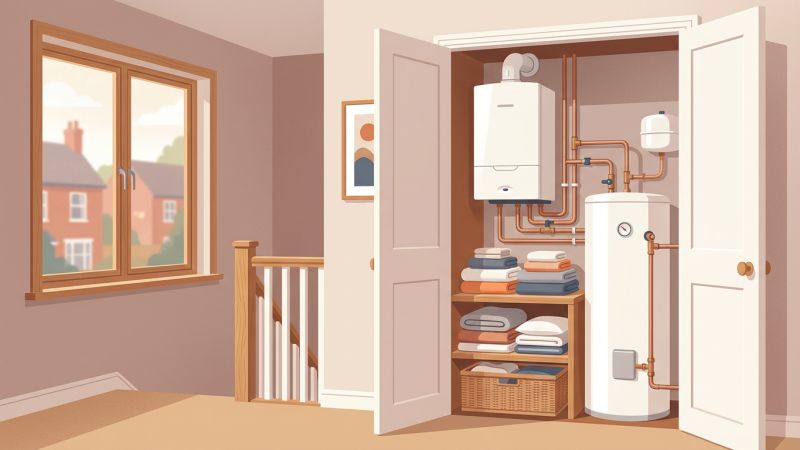
What does a system boiler actually do?
A system boiler does two jobs: it pumps hot water round your radiators, and it heats a coil inside a hot water cylinder so the cylinder can supply your taps and showers. It does not heat tap water directly, which is the key difference from a combi.
It sits between the other two layouts found in British homes. Like a combi, it is a sealed, pressurised appliance with the pump and expansion vessel inside the casing, so nothing lives in the loft. Like a regular boiler, it relies on a cylinder for hot water. Among the three main kinds of boiler used in UK homes, it is the one most installers recommend for a family house with two bathrooms.
Nearly every new model is a gas system boiler, with oil versions from makers such as Grant for homes off the gas grid. All are condensing.
How does a system boiler work?
In short: the boiler heats water, a motorised valve sends it either to the radiators or through a coil in the cylinder, and the cylinder stores hot water at mains pressure until you open a tap. If you are picturing a system boiler diagram, those are its three parts. Here is the sequence through a typical day.
- The room thermostat or programmer calls for heat. The boiler fires, and its internal pump pushes hot water out through the flow pipe at the temperature you have set, typically 60-70°C.
- A motorised valve directs the flow. On most systems a three-port valve (a Y-plan) or two two-port valves (an S-plan) decide whether hot water goes to the radiators, to the cylinder coil, or to both.
- Radiators warm the rooms. Cooler water returns to the boiler through the return pipe to be reheated. The circuit is sealed and sits at 1-1.5 bar when cold, exactly as in a combi.
- The cylinder thermostat calls for hot water. The valve opens the cylinder circuit and boiler water passes through a coil inside the cylinder, heating the stored mains water around it without the two ever mixing.
- The cylinder reaches temperature, usually 60°C, the valve closes and the boiler either carries on with the radiators or shuts down.
- You open a hot tap or shower. Stored water leaves the cylinder at mains pressure. The boiler is not involved until the cylinder thermostat asks for a reheat.
Because the hot water is already stored, two showers can run at once without either going lukewarm; the trade-off is a 20-40 minute reheat once the cylinder is empty.
What is an unvented cylinder, and why does it matter?
Most new system boilers are paired with an unvented cylinder: a strongly built, insulated steel tank fed directly from the cold mains at mains pressure. Because there is no cold water storage tank above it, there is no "system boiler tank" in the loft at all, and the hot water comes out of the taps with the same force as the cold.
Unvented cylinders range from about 120 litres for a small household to 300 litres for a large one, with 180-250 litres the common choice for a two-bathroom house. They carry their own expansion vessel, safety valves and a discharge pipe, and under Building Regulations they must be installed by an engineer holding the unvented hot water (G3) qualification as well as Gas Safe registration.
The alternative is a vented cylinder, the copper type in older airing cupboards, fed from a cold tank in the loft. A system boiler can work with one, but you lose the mains-pressure showers that make the layout worthwhile. Sizes, reheat times and the vented versus unvented choice are covered in our guide to how boilers and hot water cylinders work together.
What are the pros and cons of a system boiler?
The main advantage is strong hot water to several outlets at once; the main drawbacks are the space a cylinder takes and the wait once it runs cold. The table sets out the rest.
| Advantages | Disadvantages |
|---|---|
| Strong, even hot water to two or more outlets at once, at mains pressure with an unvented cylinder | Needs space for a cylinder, usually an airing cupboard |
| No loft tanks, so the loft can be cleared or converted | Hot water is finite: run the cylinder dry and you wait 20-40 minutes |
| Pump and expansion vessel built in, so fewer external parts than a regular boiler | Stored water loses a little heat, a few pence a day with modern insulation |
| Works with solar thermal panels and is the natural layout for a later heat pump | Costs more than a combi swap once a new cylinder is included |
| Boiler output can be lower than a combi for the same house, so it runs in its efficient condensing range for longer | Unvented cylinders need an annual check alongside the boiler service |
| Hot water still available from an immersion heater if the boiler fails | Two appliances to install and maintain instead of one |
The decision usually turns on one question: how often do two showers or a shower and a bath run at the same time? If the answer is "most mornings", stored hot water wins. Our comparison of a system boiler versus a combi boiler works through the difference between combi boiler and system boiler layouts in detail.
Which kW output should you choose?
Most houses need a 15-24 kW system boiler; 30 kW and above is for large homes with many radiators. Unlike a combi, where the kW figure is driven by instant hot water, a system boiler's output only has to heat the radiators and reheat the cylinder, so people searching for a 30kW system boiler or a 35kW system boiler are often buying more than they need.
| Home | Radiators | Typical output | Cylinder |
|---|---|---|---|
| 2-3 bed house, one or two bathrooms | 8-12 | 15-18 kW | 150-180 litres |
| 3-4 bed house, two bathrooms | 12-15 | 18-24 kW | 180-210 litres |
| 4-5 bed house, two or three bathrooms | 15-20 | 24-30 kW | 210-250 litres |
| Large detached or extended house | 20+ | 30-40 kW | 250-300 litres |
A 40kW system boiler or a 50kW system boiler belongs in a very large property or a small block of flats, not a normal family home. If you are wondering what size system boiler you need, add up the radiator output, allow about 3 kW for the cylinder coil, and round up to the nearest model. The full method, with a calculator, is in our guide on working out what size boiler your home needs. Oversizing wastes money and makes the boiler cycle on and off instead of condensing steadily.
Which manufacturers make system boilers?
Every major brand sells a system version of its main range, with the same heat exchanger and controls as the combi minus the plate exchanger and diverter valve. The table lists what the manufacturers publish at the time of writing; model line-ups change, so confirm outputs and terms on the maker's own site before you buy.
| Range | What the manufacturer publishes | Notes |
|---|---|---|
| Vaillant ecoTEC plus system | Models numbered by output, so a 630 is a 30 kW and a 635 a 35 kW unit | The vaillant system boiler most often quoted for family homes; ecoFIT pure is the cheaper line |
| Baxi 800 System 2 and 600 System 2 | 10-year and 7-year parts and labour warranties respectively | The Megaflo Compact System (7 years) is a Baxi-group stablemate |
| Ideal Logic Max System 2 and Vogue Max System | 10 and 12 year warranties | Logic+ System carries 7 years |
| Worcester Bosch Greenstar system versions | Greenstar 4000 and 8000 ranges | Guarantee and outputs published on worcester-bosch.co.uk |
| Viessmann Vitodens 050-W, 100-W and 200-W | Outputs up to 35 kW; 10, 12 and 10 year warranties when registered via VPlus | All three are sold as combi and system versions |
| Alpha, Atag, Navien, Main | Budget to mid-range alternatives | Check each maker's site for outputs and terms |
There is no single best system boiler; the right one matches your radiators, comes from a brand with a long guarantee and is fitted by an installer who knows it. The brand-by-brand picture is in our guide to the best boilers in the UK.
Who does a system boiler suit?
Run down both lists. If most of the first group applies, a new system boiler is the sensible choice.
A system boiler is a good fit if:
- you have two or more bathrooms that are used at the same time;
- your household is four people or more, with showers clustered in the morning;
- the mains flow is modest, under about 12 litres a minute, so a combi would struggle;
- you already have an airing cupboard and would like to keep stored hot water;
- you want to clear tanks from the loft but keep a cylinder;
- you are considering solar thermal now or a heat pump within the boiler's lifetime.
Consider another layout if:
- you live in a flat or a one-bathroom house with strong mains pressure, where a combi boiler is cheaper and frees the cupboard;
- you have no room for a cylinder and no wish to find any;
- your existing regular boiler, tanks and vented cylinder are sound and you want the cheapest like-for-like swap, in which case a regular or heat-only boiler may be the simpler replacement;
- hot water demand is light and intermittent, so a cylinder would spend the day keeping water warm for nobody.
Many people searching "replace system boiler with combi" are in the second group: one bathroom, a cupboard they want back and a cylinder past its best. Others go the opposite way after adding an en-suite. Neither conversion is cheap.
What does a system boiler cost to fit?
A like-for-like swap, keeping a sound cylinder, typically costs £2,000-£4,000 fitted in 2026, including the boiler, flue, magnetic filter, controls and labour. Budget brands at 15-18 kW sit near the bottom; a 30-35 kW premium model with a 10-12 year guarantee sits near the top.
| Job | Typical fitted price |
|---|---|
| System boiler swap, existing cylinder kept | £2,000-£4,000 |
| New unvented cylinder added | £800-£1,500 extra |
| Combi to system boiler and cylinder | Above the top of the swap range, because of new pipework |
| System boiler to combi | £2,500-£5,000 |
The itemised figures, supply-only prices and brand comparisons are in our combi and system boiler cost guide.
Frequently asked questions
What is a system boiler in simple terms?
A system boiler heats your radiators directly and heats a hot water cylinder, usually an unvented one fed straight from the mains. The pump and expansion vessel are built into the boiler, so there are no tanks in the loft and the heating circuit is sealed and pressurised. You get stored hot water at mains pressure to several taps at once, at the cost of an airing cupboard for the cylinder.
How does a system boiler work with an unvented cylinder?
The boiler heats water and a motorised valve sends it either to the radiators or through a coil inside the cylinder. The coil warms the stored mains water without mixing with it. When the cylinder thermostat is satisfied, the valve closes and the boiler returns to heating only. Because the cylinder is pressurised by the mains, hot water reaches showers and taps at strong, even flow with no pump.
What size system boiler do I need?
Most homes need less than they expect. The output heats the radiators and reheats the cylinder, not the hot taps directly, so 15-18 kW suits a typical three-bedroom house with up to about twelve radiators, 24 kW a four-bedroom house, and 30-35 kW a large detached home with many radiators or a big cylinder. Add roughly 3 kW for cylinder reheat on top of the radiator total, and resist oversizing.
Is a system boiler better than a combi?
It depends on how many showers run at once. A combi gives unlimited hot water to one outlet at a time and needs no cylinder. A system boiler with an unvented cylinder keeps two showers running at full strength and suits homes with two or more bathrooms, weak mains flow or plans for solar thermal or a heat pump. For a flat or a one-bathroom house, a combi is cheaper and simpler.
Does a system boiler need a tank in the loft?
No. The expansion vessel and pump inside the boiler replace the feed-and-expansion tank, and an unvented cylinder replaces the cold water storage tank, so the loft can be cleared. The only exception is a system boiler paired with an older vented cylinder, which still needs a cold water tank above it to provide the head of pressure. That set-up is usually a short-term way to keep an existing cylinder.
How much does a new system boiler cost?
A like-for-like system boiler swap, keeping the existing cylinder, typically costs £2,000-£4,000 fitted in the UK, depending on brand, output and the complexity of the flue and pipework. A new unvented cylinder adds roughly £800-£1,500. Converting from a combi to a system boiler and cylinder costs more again because of the pipework and cylinder installation, while going the other way is usually £2,500-£5,000.
Sources and further reading
- Vaillant UK - System boilers
- Baxi - System boilers
- Ideal Heating - System boilers
- Worcester Bosch - System boilers
- Energy Saving Trust - Boilers
- GOV.UK - Approved Document G: Sanitation, hot water safety and water efficiency
Prices and scheme details were checked on 22 October 2026 and are shown as typical ranges. Always get written quotes from Gas Safe registered installers.