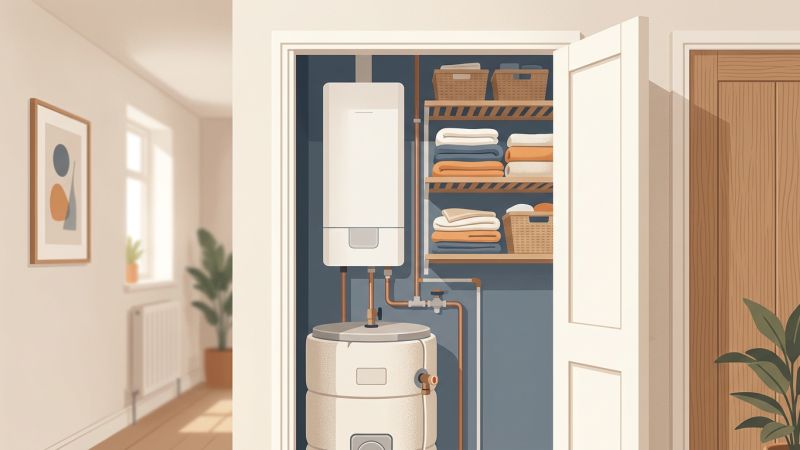
What are the options for heating hot water only?
There are four: a cylinder with immersion heaters, a small electric flow boiler feeding a cylinder, an instantaneous water heater, or point-of-use heaters at each outlet. Most people asking have a flat with no gas, a garden annexe, an off-grid cottage, or a house where something else heats the rooms. Where electric heating fits alongside heat pumps is covered in our hub on heat pumps versus gas boilers.
| Option | How it works | Typical fitted cost | Best for |
|---|---|---|---|
| Hot water cylinder with immersion heater(s) | A 3 kW element heats a stored tank of 90-300 litres, usually overnight on a cheaper tariff | £150-£300 to replace an immersion; £1,200-£2,500 for a new unvented cylinder with two immersions | Flats and houses with an airing cupboard, Economy 7 or similar tariffs |
| Small electric flow boiler feeding a cylinder | A 6-12 kW wall-hung unit heats water through a coil in the cylinder, like a gas system boiler | £1,500-£3,000 for the unit fitted, cylinder extra | Homes that want fast reheating, or may add radiators later |
| Instantaneous multipoint water heater | A 9-12 kW heater warms water as it passes, with no storage | £500-£1,200 fitted | Small flats, annexes, holiday lets with one bathroom |
| Point-of-use heaters | A 2-3 kW under-sink unit, either 5-15 litre storage or instantaneous, serving one tap | £200-£450 fitted per outlet | Cloakrooms, garages, offices, outbuildings |
Prices are typical UK ranges at the "Last updated" date above and depend on cylinder size, wiring runs and whether a new circuit is needed.
How does each option actually heat the water?
Immersion heaters are the simplest. A 3 kW element inside the cylinder heats the stored water to a thermostat setting, typically 60°C to control bacteria. Twin-immersion cylinders put one element near the top for a quick boost and one at the bottom to heat the whole tank overnight.
Electric flow boilers work like a gas system boiler without the gas. A compact wall-hung unit, often 6, 9 or 12 kW, contains elements that heat water circulating through a coil inside the cylinder. It reheats a large cylinder faster than an immersion, and the same unit can later run a few radiators or underfloor heating. The technology is explained in our guide to how electric boilers work.
Instantaneous water heaters have no tank. Water passes over an element on its way to the tap and arrives hot a few seconds later. Flow is limited by the heater's power: a 10 kW unit gives roughly 4 litres a minute at a 35°C temperature rise, enough for a basin or a modest shower but not a bath. An electric combi works on the same principle at a larger scale; we cover its limits in our guide to electric combi boilers.
Point-of-use heaters are small instantaneous or storage units fitted under or over a single sink, avoiding long pipe runs and the water wasted waiting for the hot to arrive.
What does electric hot water cost to run compared with gas?
Roughly three times as much per kilowatt-hour on a standard tariff, and about one and a half to two times as much on an off-peak tariff. The relationship matters more than any single figure, which will date quickly.
Two numbers drive it. The first is the unit price of electricity relative to gas: under the Ofgem price cap, a kilowatt-hour of electricity has typically cost around three and a half to four times as much as a kilowatt-hour of gas in recent years, and the current rates are on Ofgem's price cap page, listed in our sources. The second is efficiency. A direct electric heater turns almost all of its electricity into hot water, while a gas boiler heating a cylinder manages perhaps 80-90% after flue and standing losses. Here is an illustration for a household using about 2,500 kWh of hot water a year, reasonable for two or three people:
| Method | Illustrative price per kWh | Efficiency | Annual hot water cost |
|---|---|---|---|
| Gas boiler and cylinder | 6p | 85% | about £175 |
| Electric immersion or flow boiler, standard tariff | 25p | 100% | about £625 |
| Electric immersion, off-peak tariff (seven hours overnight) | 13p | 100% | about £325 |
| Hot water heat pump cylinder | 25p | 250-300% (COP 2.5-3) | about £210-£250 |
The prices in the table are round numbers chosen to show the relationship; substitute your own tariff. The off-peak row is what makes electric hot water affordable: a well-insulated cylinder heated overnight loses little during the day. The heat pump row is for a hot water heat pump, a cylinder with a small heat pump on top drawing warmth from the room or outside air; pricing for heat pumps generally is in our guide to heat pump costs. For the heating side of the same comparison, see electric boiler versus gas boiler running costs.
Who is an electric hot water only system right for?
The homes where electric hot water makes sense share one feature: gas is unavailable or not worth connecting for the amount of hot water needed.
- Flats with no gas supply. Many purpose-built blocks are all-electric by design; a cylinder with immersions, or an instantaneous heater for a one-bedroom flat, is the standard solution.
- Off-gas houses with a different heat source. If a wood stove, storage heaters or a heat pump handle the heating, a cylinder with an immersion is often simpler than running the main system for summer hot water.
- Annexes, garden offices and outbuildings. A point-of-use heater or a small instantaneous unit avoids running a hot pipe from the house.
- Holiday lets and second homes. Instant heaters have nothing to keep warm when the property is empty.
- Households with solar panels. A diverter sends surplus daytime generation to the immersion, giving effectively free hot water for much of the year.
Electric hot water is a poor fit for a large family on the gas grid: the running cost gap is too wide and a gas boiler will be cheaper over its life. For the gas side of the comparison, start with our guide to what a new boiler costs.
How big a heater or cylinder do you need?
Allow 35-45 litres of stored hot water per person per day, or about 2.4 kW of instantaneous heater power for every litre a minute you want. Sizing is about litres and recovery time, not kilowatts alone.
Cylinder size. The per-person rule gives roughly 90-120 litres for one or two people, 150-210 litres for three or four, and 250-300 litres for five or more, or for homes with a large bath. Unvented cylinders need a G3-qualified installer and an expansion vessel; vented cylinders need a cold water tank above them. Our guide to how boilers and hot water cylinders work together explains both layouts.
Recovery time. A 3 kW immersion adds about 3 kWh of heat an hour, which warms roughly 50 litres from cold to 60°C, so a 150 litre cylinder takes about three hours from cold and a 9 kW flow boiler does the same job in about an hour.
Instantaneous heaters. Work backwards from the flow you want: at a 35°C temperature rise, a 9 kW heater gives around 3.7 litres a minute and a 12 kW unit about 5. A comfortable shower needs 6-8 litres a minute, which is why instantaneous heaters suit basins better than bathrooms unless you accept a modest shower.
Electrical supply. A 3 kW immersion runs on its own 16 A circuit. A 9-12 kW heater draws 40-52 A at 230 V and needs a dedicated circuit; two of them may exceed a standard single-phase supply. Have an electrician check before anything is ordered.
Can I use a combi boiler for hot water only?
Yes, and plenty of households do exactly that from May to September by turning the heating off at the programmer. A combi only fires when a tap opens, so there is no waste. Buying a new combi purely for hot water is different: you pay for 24-30 kW of heating capacity to do a job a 9 kW heater or a cylinder could do. A combi earns its place when you want heating and hot water from one box.
Are catering and office water boilers the same thing?
No, and the shared name causes confusion. A catering water boiler, also called a water boiler urn or instant hot water boiler, is a countertop or wall-mounted appliance holding 5-40 litres at boiling point for tea and coffee. Brands such as Burco, Lincat, Instanta, Marco, Buffalo, Calomax and Zip make them, and autofill versions plumb into the mains. Swan, Breville and Zojirushi make smaller domestic versions, and a one-cup water boiler is essentially a fast kettle.
None of these heats the water at your taps or shower. If you want a tea urn for an office, a catering supplier will serve you better than a heating site.
Which option should you choose?
- Choose a cylinder with twin immersions if you have an airing cupboard, an off-peak tariff, and two or more people using baths and showers.
- Choose a small electric flow boiler and cylinder if you want faster reheating, or may add radiators or underfloor heating later.
- Choose an instantaneous multipoint heater if space is tight, occupancy is low or intermittent, and a basin-and-shower level of flow is acceptable.
- Choose point-of-use heaters for single outlets a long way from any hot water source.
- Consider a hot water heat pump cylinder if you use a lot of hot water on a standard tariff; it cuts running costs by more than half compared with an immersion.
- Think again about gas if a supply is already in the property and the household is large; the running cost gap usually outweighs the lower price of electric kit.
Whichever you choose, insist on an insulated cylinder, a timer or smart control, and a thermostat at 60°C. Those details decide the bills far more than the badge on the heater.
Frequently asked questions
What is the best electric boiler for hot water only?
For most homes the best option is not a boiler at all but a well-insulated hot water cylinder with one or two immersion heaters, ideally run on a cheaper off-peak tariff. A small electric flow boiler feeding a cylinder makes sense when you want faster reheating or plan to add radiators later. For a single basin or an annexe kitchen, a point-of-use water heater is cheaper to buy and run than either.
Can I use a combi boiler for hot water only?
Yes. A gas or electric combi will happily supply hot water with the heating switched off at the controls, and many people run them this way all summer. Buying a combi purely for hot water is rarely sensible, though, because you pay for heating capacity you never use. A cylinder with an immersion, or an instantaneous multipoint water heater, does the same job for less money and with simpler maintenance.
How much does it cost to heat water with electricity?
It depends on your unit rate, which is why we point you to the Ofgem price cap page rather than quoting a fixed figure. As a rule of thumb, electricity has cost around three and a half to four times as much per kWh as gas in recent years, and a direct electric heater turns almost all of it into hot water. So each kWh of hot water costs roughly three times what it would from a gas boiler, unless you heat the cylinder on an off-peak tariff.
How long does an immersion heater take to heat a tank?
A standard 3 kW immersion heater raises 120 litres of water from 10°C to 60°C in a little over two hours, and a 210 litre cylinder in around four hours, assuming the cylinder is well insulated. Fitting two immersions, one at the top for a quick boost and one at the bottom for a full overnight heat, is the usual way to get both speed and cheap running. A 6 to 12 kW electric flow boiler cuts those times by half or more.
Do I need an electrician to fit an electric water heater?
Almost always. A 3 kW immersion needs its own circuit and switch, and a 9 to 12 kW instantaneous heater draws 40 to 50 amps and needs a dedicated circuit from the consumer unit. In England and Wales this is notifiable work under Part P of the Building Regulations, so use an electrician registered with a competent person scheme who can certify it. The plumbing side can be done by a plumber or, for unvented cylinders, a G3-qualified installer.
Is a catering water boiler the same as a hot water boiler for a home?
No. A catering or office water boiler from brands such as Burco, Lincat, Instanta or Marco is a countertop or wall-mounted urn that keeps a few litres at boiling point for tea and coffee, and autofill versions plumb into the mains. It has nothing to do with heating a home's taps and showers. If you searched for a water boiler and landed here wanting one for tea, a catering supplier is where to look.
Sources and further reading
- Ofgem - Energy price cap (current unit rates for gas and electricity)
- GOV.UK - Approved Document P: electrical safety (Building Regulations)
- Energy Saving Trust - Home energy advice
- Heatrae Sadia - Electric water heating and cylinders
- The Electric Heating Company - Electric boilers and cylinders
Prices and scheme details were checked on 22 October 2026 and are shown as typical ranges. Always get written quotes from Gas Safe registered installers.